Do you want to know more?
The Nisenan language and the SSBMI Community
The SSBMI Community has ancestral ties to the Valley and Southern Hill dialects of the Nisenan language through the Tribe's Matriarchs, Pamela Cleanso Adams and Annie Hill Murray Paris.
Pamela spoke the Valley dialect and she, her brother Tom Cleanso, and her daughter Lillie Williams are responsible for passing on most of the knowledge we have of Valley Nisenan today. We have less direct information about Annie’s language; based on where she was from and documented language from her relations and associates, she likely spoke Southern Hill Nisenan.
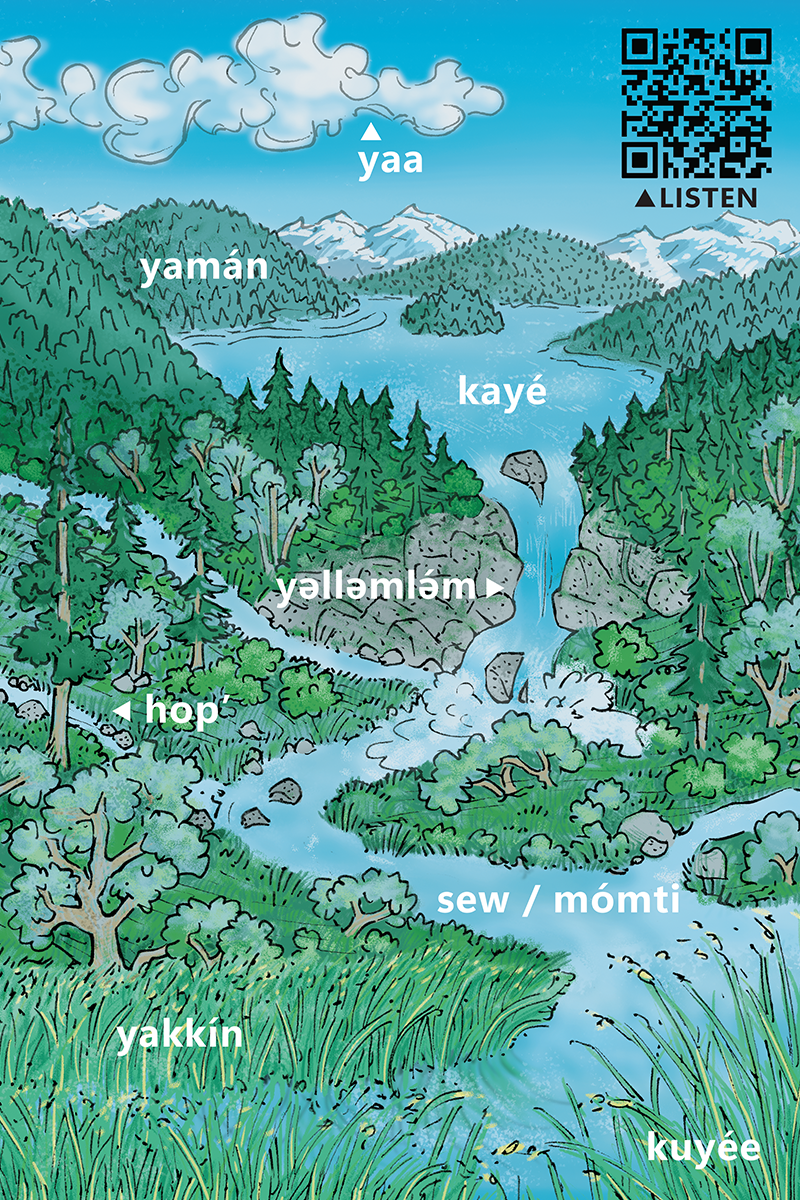
You will notice that some words differ between these dialects. For example, sew and mómti are two ways to say "river" in Nisenan. The word mómti comes from the Valley dialect of Nisenan.
You can learn more about the Nisenan language and its dialects by reading our "Language FAQ" pamphlet.
River names in Nisenan
In English, geographical features like rivers often receive one official name which can be found on maps and signs and is generally shared by all English speakers, regardless of where they are from (with some exceptions). However, any given river often has several traditional names in the Nisenan language. This is because traditional Nisenan naming practices differ from those of modern English.
Nisenan speakers usually refer to rivers using descriptive phrases grounded in the speaker's own physical location or perspective. For example, Tom Cleanso was a Nisenan man who lived at Pusúune at the confluence of the Sacramento and American rivers, and he called the Sacramento River Táamom (West Water) and the American River Nótowmom (East Water). His names are derived from their locations relative to his home.
English
Sacramento River
(literal: West Water)
American River
(literal: East Water)
Speakers from other areas use different names for these rivers. For example, William Joseph (a.k.a. Bill Joe), a Nisenan man from Amador County, called the Sacramento River the Wollokóm Sew and the American River the K’ademmám Sew, naming them after the villages of Wóllok and K’ademmá respectively. Wóllok and K’ademmá are major village sites that lie along each of these rivers.
English
Sacramento River
(literal: Wóllok River)
American River
(literal: K’ademmá River)
As you can see, there is often not a single "correct" Nisenan name for any given river; instead, there are many valid traditional names. Recognizing this difference between English and Nisenan naming practices is an important part of reclaiming and revitalizing Nisenan language and culture. We often share Tom Cleanso's river names because he is a close relative of the Tribe and his names are strongly tied to Pusúune, an important ancestral village site for the SSBMI Community, but other Nisenan river names are valid too.