Koymóon C’aan Ha (Snakes & Logs)
A Nisenan-language version of Snakes & Ladders
Ages 3+, 2-5 players (or more!)
Instructions
Put your game pieces at the hoyyahá (start).
Take turns rolling one dice and moving your game piece forward the number of spaces you rolled.
Important!
You are only allowed to move forward if you count out loud in Nisenan as you move. If you don’t count out loud in Nisenan and another player calls you out, you forfeit your turn! Players can and should help each other count.
Example
You roll c’ɨɨy (four). You must count out wíttee, peen, sapwíy, c’ɨɨy (one, two, three, four) as you move your game piece forward four spaces. You can listen to the numbers on the "Nisenan Numbers" tab of this webpage.
Koymóo (rattlesnakes) move you backward
If you land on the head of a small koymóo, you must slide all the way down to the tail of that koymóo.
C’aa (logs) move you forward
If you land on the lower end of a c’aa, you can cross the c’aa and land on the space at the other end.
The first player to reach the wɨw (goal) wins!
You do not have to roll the exact number to reach the wɨw.
Variations
Lightning Mode
Play with two dice to make the game faster and to practice the numbers 1-12. All the regular rules apply. You can listen to the numbers on the "Nisenan Numbers" tab of this webpage.
Language Challenge Mode
Choose a person to be the Challenge Master; that person does not compete in the game.
Agree on a list of 2-5 Nisenan words or phrases for all the players to learn. Players review them before the game. The Challenge Master keeps the list hidden during the game.
When a player lands on the head of a koymóo, they can move one space further, escaping the koymóo, by passing a Language Challenge given by the Challenge Master.
Example Language Challenge
The group has chosen these phrases to learn:
| Homáabe mi? | How are you? |
| Wenném ni. | I'm good. |
| Uk’oyím ni. | Goodbye. |
Player 1 lands on the head of a koymóo. The Challenge Master quizzes the imperiled player by asking questions like:
| What does Uk’oyím ni mean? | (Answer: Goodbye.) |
| How do you say "I'm good"? | (Answer: Wenném ni.) |
| How do you ask someone how they're doing? | (Answer: Homáabe mi?) |
If Player 1 answers the Language Challenge correctly, she can move forward one space, avoiding the koymóo. If not, she slides down to the tail like normal. Then the Challenge Master should review the group's challenge language with all the players, and gameplay continues.
Want suggestions for language to use in Language Challenge Mode? Check out our greetings webpage, any of our flashcard sets, and our language posters! We would like to thank some of the 3rd grade students at the 2025 California Indian Cultural Education Day program for suggesting this variation on Koymóon C’aan Ha. Wenném! (Thanks!)
Nisenan numbers
The Nisenan Language
The Nisenan language has four major dialects; you can see approximately where these dialects are spoken on the map below:
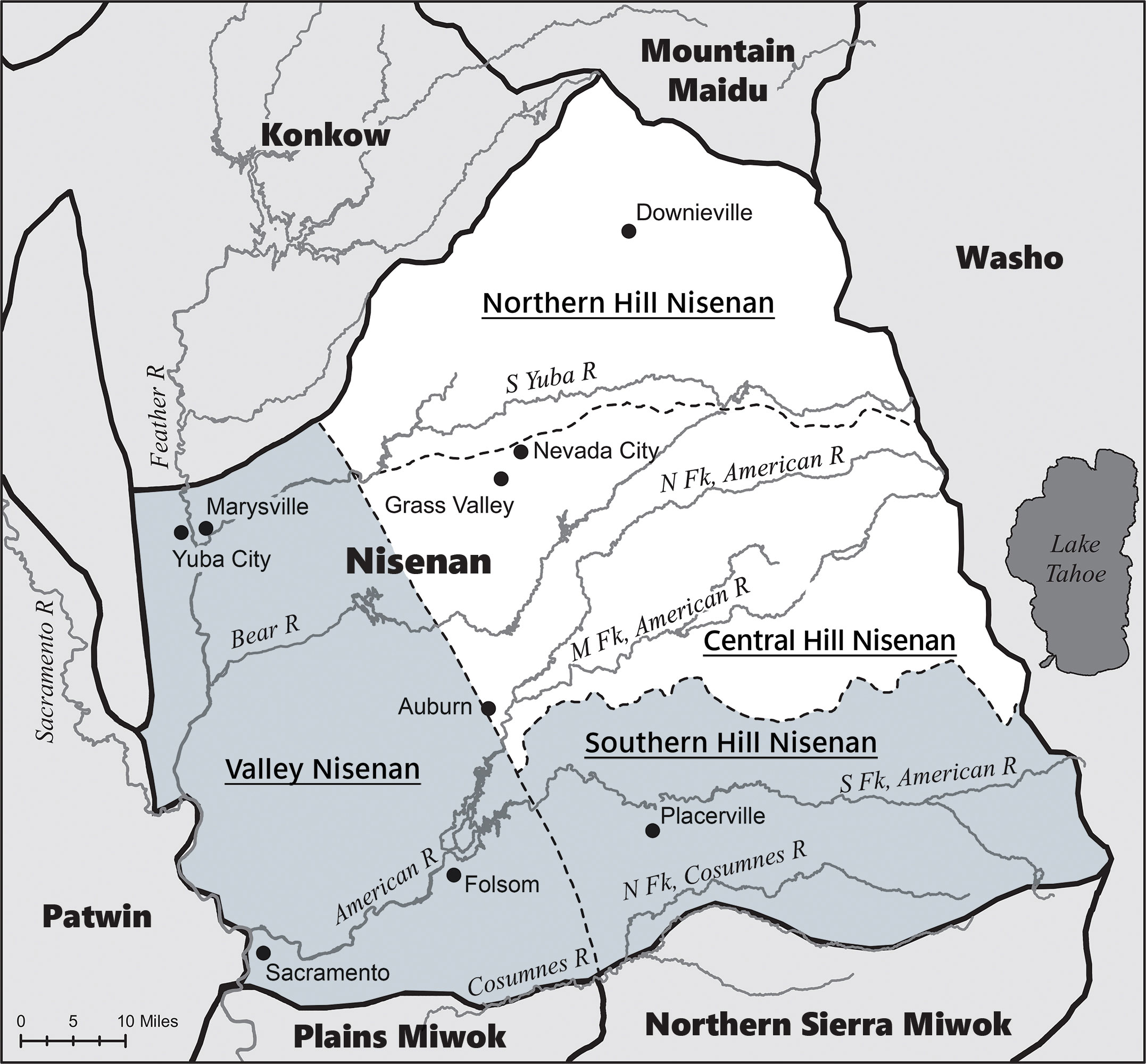
Map adapted from the book "California Indian languages" by Victor Golla (2011).
The SSBMI Community has ties to the Nisenan language through the Tribe's Matriarchs, Pamela Cleanso Adams and Annie Hill Murray Paris. Pamela spoke Valley Nisenan and, based on where she was from and the language of her relations, Annie likely spoke Southern Hill Nisenan.
Nisenan Numbers
Speakers from different areas use some different numbers. Even in the same area, there is often more than one way to say a given number. This can be overwhelming when you are learning the language! We recommend learning one system first as a foundation; then you can learn variations on that system.
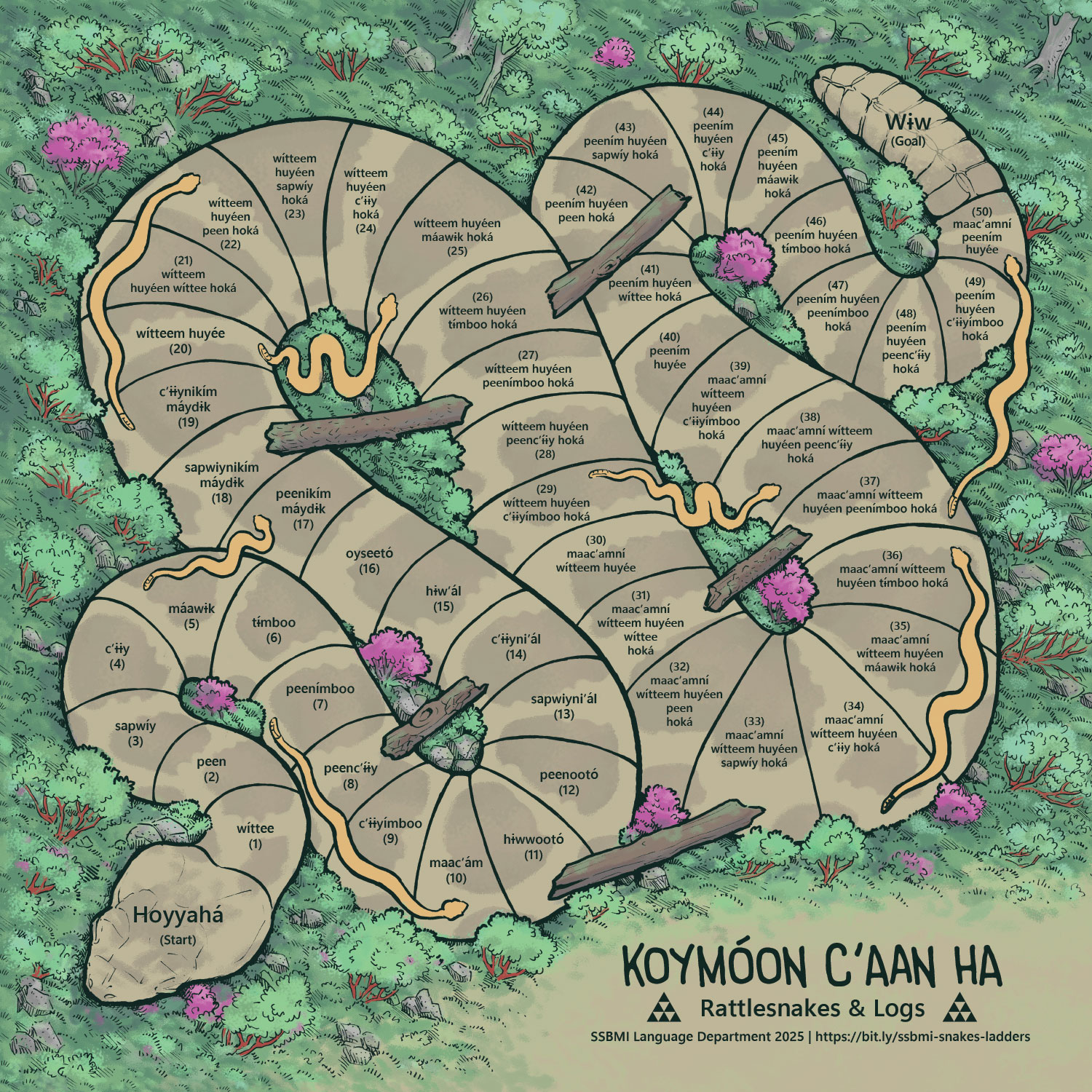
This gameboard features just one of several ways to count from 1 to 50 in Southern Hill Nisenan, the dialect that Annie Hill Murray Paris likely spoke. We learn this number system primarily from William Joseph (a.k.a. Bill Joe), who also passed on the story of Hiik’í that inspired our gameboard design. You can explore the table below to listen to this way of counting from 1-50!
| Nisenan | English | ||
|---|---|---|---|
| wíttee |
|
1 | |
| peen |
|
2 | |
| sapwíy |
|
3 | |
| c’ɨɨy |
|
4 | |
| máawɨk |
|
5 | |
| tɨ́mboo |
|
6 | |
| peenímboo |
|
7 | |
| peenc’ɨ́ɨy |
|
8 | |
| c’ɨɨyímboo |
|
9 | |
| maac’ám |
|
10 | |
| hɨwwootó |
|
11 | |
| peenootó |
|
12 | |
| sapwiyni’ál |
|
13 | |
| c’ɨɨyni’ál |
|
14 | |
| hɨw’ál |
|
15 | |
| oyseetó |
|
16 | |
| peenikím máydɨk |
|
17 | |
| sapwiynikím máydɨk |
|
18 | |
| c’ɨɨynikím máydɨk |
|
19 | |
| wítteem huyée |
|
20 | |
| wítteem huyéen wíttee hoká |
|
21 | |
| wítteem huyéen peen hoká |
|
22 | |
| wítteem huyéen sapwíy hoká |
|
23 | |
| wítteem huyéen c’ɨɨy hoká |
|
24 | |
| wítteem huyéen máawɨk hoká |
|
25 | |
| wítteem huyéen tɨ́mboo hoká |
|
26 | |
| wítteem huyéen peenímboo hoká |
|
27 | |
| wítteem huyéen peenc’ɨ́ɨy hoká |
|
28 | |
| wítteem huyéen c’ɨɨyímboo hoká |
|
29 | |
| maac’amní wítteem huyée |
|
30 | |
| maac’amní wítteem huyéen wíttee hoká |
|
31 | |
| maac’amní wítteem huyéen peen hoká |
|
32 | |
| maac’amní wítteem huyéen sapwíy hoká |
|
33 | |
| maac’amní wítteem huyéen c’ɨɨy hoká |
|
34 | |
| maac’amní wítteem huyéen máawɨk hoká |
|
35 | |
| maac’amní wítteem huyéen tɨ́mboo hoká |
|
36 | |
| maac’amní wítteem huyéen peenímboo hoká |
|
37 | |
| maac’amní wítteem huyéen peenc’ɨ́ɨy hoká |
|
38 | |
| maac’amní wítteem huyéen c’ɨɨyímboo hoká |
|
39 | |
| peením huyée |
|
40 | |
| peením huyéen wíttee hoká |
|
41 | |
| peením huyéen peen hoká |
|
42 | |
| peením huyéen sapwíy hoká |
|
43 | |
| peením huyéen c’ɨɨy hoká |
|
44 | |
| peením huyéen máawɨk hoká |
|
45 | |
| peením huyéen tɨ́mboo hoká |
|
46 | |
| peením huyéen peenímboo hoká |
|
47 | |
| peením huyéen peenc’ɨ́ɨy hoká |
|
48 | |
| peením huyéen c’ɨɨyímboo hoká |
|
49 | |
| maac’amní peením huyée |
|
50 |
Hiik’í: The Big Snake
Unlike typical Snakes & Ladders gameboards, this one is laid out on the body of a giant snake and players move from its c’ol (head) to buk (tail).
This gameboard's design is inspired by the story of Hiik’í, the Big Snake, as told by William Joseph (a.k.a. Bill Joe). Bill Joe was a Nisenan man from Amador County who worked with linguists/anthropologists in the early 1900's, passing on a rich legacy of Nisenan language and culture.
Listen to SSBMI Language staff read the story of Hiik’í as told by Bill Joe:
Additional gameplay language
Most of us don't play boardgames in total silence! So why not speak more Nisenan as you play? Explore the table below to learn some of the Nisenan phrases we often use while playing Koymóon C’aan Ha and other games.
Try using Language Challenge Mode (see the "Instructions" tab) to practice these phrases!
| Nisenan | English | ||
|---|---|---|---|
| Koymóon C’aan Ha |
|
Rattlesnakes and Logs | |
| koymóo |
|
rattlesnake, snake | |
| Hiik’í |
|
name of the Big Snake | |
| c’aa |
|
tree, stick, log | |
| hoyyahá |
|
beginning, start | |
| wɨw |
|
goal | |
| K’aatopé! |
|
Let's play! (said to 2+ people) |
|
| Mi k’aak’é. |
|
It's your turn. (said to 1 person) |
|
| Nɨn! |
|
Roll! (said to 1 person) |
|
| Halém ni! |
|
I win! | |
| Halemeyím ni. |
|
I lose. |
Get the Game
The SSBMI Language Department gave out copies of Koymóon C’aan Ha to SSBMI Tribal Member households at the 2026 Annual Meeting. If you are an SSBMI Tribal Member and have not received your game, please email us at language@ssband.org.
Not an SSBMI Tribal Member and/or don't have an "official" Koymóon C’aan Ha game set? You can still play the game! You can download, print, and tape together your own gameboard and use dice and game pieces from other games you have in your home:
Download a print-at-home version of the gameboard and instructions
Want to save ink? Download a black and white, low-ink version
Instructions
Put your game pieces at the hoyyahá (start).
Take turns rolling one dice and moving your game piece forward the number of spaces you rolled.
Important!
You are only allowed to move forward if you count out loud in Nisenan as you move. If you don’t count out loud in Nisenan and another player calls you out, you forfeit your turn! Players can and should help each other count.
Example
You roll c’ɨɨy (four). You must count out wíttee, peen, sapwíy, c’ɨɨy (one, two, three, four) as you move your game piece forward four spaces. You can listen to the numbers on the "Nisenan Numbers" tab of this webpage.
Koymóo (rattlesnakes) move you backward
If you land on the head of a small koymóo, you must slide all the way down to the tail of that koymóo.
C’aa (logs) move you forward
If you land on the lower end of a c’aa, you can cross the c’aa and land on the space at the other end.
The first player to reach the wɨw (goal) wins!
You do not have to roll the exact number to reach the wɨw.
Variations
Lightning Mode
Play with two dice to make the game faster and to practice the numbers 1-12. All the regular rules apply. You can listen to the numbers on the "Nisenan Numbers" tab of this webpage.
Language Challenge Mode
Choose a person to be the Challenge Master; that person does not compete in the game.
Agree on a list of 2-5 Nisenan words or phrases for all the players to learn. Players review them before the game. The Challenge Master keeps the list hidden during the game.
When a player lands on the head of a koymóo, they can move one space further, escaping the koymóo, by passing a Language Challenge given by the Challenge Master.
Example Language Challenge
The group has chosen these phrases to learn:
| Homáabe mi? | How are you? |
| Wenném ni. | I'm good. |
| Uk’oyím ni. | Goodbye. |
Player 1 lands on the head of a koymóo. The Challenge Master quizzes the imperiled player by asking questions like:
| What does Uk’oyím ni mean? | (Answer: Goodbye.) |
| How do you say "I'm good"? | (Answer: Wenném ni.) |
| How do you ask someone how they're doing? | (Answer: Homáabe mi?) |
If Player 1 answers the Language Challenge correctly, she can move forward one space, avoiding the koymóo. If not, she slides down to the tail like normal. Then the Challenge Master should review the group's challenge language with all the players, and gameplay continues.
Want suggestions for language to use in Language Challenge Mode? Check out our greetings webpage, any of our flashcard sets, and our language posters! We would like to thank some of the 3rd grade students at the 2025 California Indian Cultural Education Day program for suggesting this variation on Koymóon C’aan Ha. Wenném! (Thanks!)
Nisenan numbers
The Nisenan Language
The Nisenan language has four major dialects; you can see approximately where these dialects are spoken on the map below:
Map adapted from the book "California Indian languages" by Victor Golla (2011).
The SSBMI Community has ties to the Nisenan language through the Tribe's Matriarchs, Pamela Cleanso Adams and Annie Hill Murray Paris. Pamela spoke Valley Nisenan and, based on where she was from and the language of her relations, Annie likely spoke Southern Hill Nisenan.
Nisenan Numbers
Speakers from different areas use some different numbers. Even in the same area, there is often more than one way to say a given number. This can be overwhelming when you are learning the language! We recommend learning one system first as a foundation; then you can learn variations on that system.
This gameboard features just one of several ways to count from 1 to 50 in Southern Hill Nisenan, the dialect that Annie Hill Murray Paris likely spoke. We learn this number system primarily from William Joseph (a.k.a. Bill Joe), who also passed on the story of Hiik’í that inspired our gameboard design. You can explore the table below to listen to this way of counting from 1-50!
| Nisenan | |
|---|---|
|
wíttee 1 |
|
|
peen 2 |
|
|
sapwíy 3 |
|
|
c’ɨɨy 4 |
|
|
máawɨk 5 |
|
|
tɨ́mboo 6 |
|
|
peenímboo 7 |
|
|
peenc’ɨ́ɨy 8 |
|
|
c’ɨɨyímboo 9 |
|
|
maac’ám 10 |
|
|
hɨwwootó 11 |
|
|
peenootó 12 |
|
|
sapwiyni’ál 13 |
|
|
c’ɨɨyni’ál 14 |
|
|
hɨw’ál 15 |
|
|
oyseetó 16 |
|
|
peenikím máydɨk 17 |
|
|
sapwiynikím máydɨk 18 |
|
|
c’ɨɨynikím máydɨk 19 |
|
|
wítteem huyée 20 |
|
|
wítteem huyéen wíttee hoká 21 |
|
|
wítteem huyéen peen hoká 22 |
|
|
wítteem huyéen sapwíy hoká 23 |
|
|
wítteem huyéen c’ɨɨy hoká 24 |
|
|
wítteem huyéen máawɨk hoká 25 |
|
|
wítteem huyéen tɨ́mboo hoká 26 |
|
|
wítteem huyéen peenímboo hoká 27 |
|
|
wítteem huyéen peenc’ɨ́ɨy hoká 28 |
|
|
wítteem huyéen c’ɨɨyímboo hoká 29 |
|
|
maac’amní wítteem huyée 30 |
|
|
maac’amní wítteem huyéen wíttee hoká 31 |
|
|
maac’amní wítteem huyéen peen hoká 32 |
|
|
maac’amní wítteem huyéen sapwíy hoká 33 |
|
|
maac’amní wítteem huyéen c’ɨɨy hoká 34 |
|
|
maac’amní wítteem huyéen máawɨk hoká 35 |
|
|
maac’amní wítteem huyéen tɨ́mboo hoká 36 |
|
|
maac’amní wítteem huyéen peenímboo hoká 37 |
|
|
maac’amní wítteem huyéen peenc’ɨ́ɨy hoká 38 |
|
|
maac’amní wítteem huyéen c’ɨɨyímboo hoká 39 |
|
|
peením huyée 40 |
|
|
peením huyéen wíttee hoká 41 |
|
|
peením huyéen peen hoká 42 |
|
|
peením huyéen sapwíy hoká 43 |
|
|
peením huyéen c’ɨɨy hoká 44 |
|
|
peením huyéen máawɨk hoká 45 |
|
|
peením huyéen tɨ́mboo hoká 46 |
|
|
peením huyéen peenímboo hoká 47 |
|
|
peením huyéen peenc’ɨ́ɨy hoká 48 |
|
|
peením huyéen c’ɨɨyímboo hoká 49 |
|
|
maac’amní peením huyée 50 |
Hiik’í: The Big Snake
Unlike typical Snakes & Ladders gameboards, this one is laid out along the body of a giant snake and players move from its c’ol (head) to its buk (tail).
This gameboard's design is inspired by the Story of Hiik’í, the Big Snake, as told by William Joseph (a.k.a. Bill Joe). Bill Joe was a Nisenan man from Amador County who worked with linguists and anthropologists in the early 1900's, passing on a rich legacy of Nisenan language and culture.
Listen to SSBMI Language staff read the story of Hiik’í as told by Bill Joe:
More gameplay language
Most of us don't play boardgames in total silence! So why not speak more Nisenan as you play? Explore the table below to learn some of the Nisenan phrases we often use while playing Koymóon C’aan Ha and other games.
Try using Language Challenge Mode (see the "Instructions" tab) to practice these phrases!
| Nisenan | |
|---|---|
|
Koymóon C’aan Ha Rattlesnakes and Logs |
|
|
koymóo rattlesnake, snake |
|
|
Hiik’í name of the Big Snake |
|
|
c’aa tree, stick, log |
|
|
hoyyahá beginning, start |
|
|
wɨw goal |
|
|
K’aatopé! Let's play! (said to 2+ people) |
|
|
Mi k’aak’é. It's your turn. (said to 1 person) |
|
|
Nɨn! Roll! (said to 1 person) |
|
|
Halém ni! I win! |
|
|
Halemeyím ni. I lose. |
Get the Game
The SSBMI Language Department handed out copies of Koymóon C’aan Ha to SSBMI Tribal Member households at the 2026 Annual Meeting. If you are an SSBMI Tribal Member and have not received your game, please email us at language@ssband.org.
Not an SSBMI Tribal Member and/or don't have an "official" Koymóon C’aan Ha set? You can still play the game! You can download, print, and tape together your own gameboard and use dice and game pieces from other games you have in your home:
Download a print-at-home version of the gameboard and instructions
Want to save ink? Download a black and white, low-ink version